What makes hospitality different
In most industries a disruption pauses the service. In hospitality the service population — guests — remains on site, with expectations intact, while your systems, utilities or surroundings fail. Continuity therefore has two simultaneous fronts: keep guests safe and informed, and keep the commercial engine running — reservations, billing, procurement — often in manual mode. Plans that cover only evacuation miss half the problem.
The five scenarios that matter
| Scenario | The hospitality-specific twist | The test of readiness |
|---|---|---|
| PMS / booking systems down | Check-ins, billing, room assignment freeze at the desk | Paper registration cards and a rate sheet, rehearsed — can the desk run 24 hours blind? |
| Power or cooling failure | In Gulf summer, cooling is life safety, not comfort | Generator load priorities decided in advance: what stays on, in what order |
| Ransomware | Guest data plus operations — a privacy incident and an outage at once | Segmented networks, offline guest list, a notification plan that satisfies PDPL |
| Area incident / access restriction | Guests cannot leave, or arrivals cannot reach you | Extended-stay provisioning and rebooking logic with sister properties |
| Reputation event | Reviews and social media amplify every hour of confusion | One voice: who speaks, holding statements ready, staff briefed on what not to say |
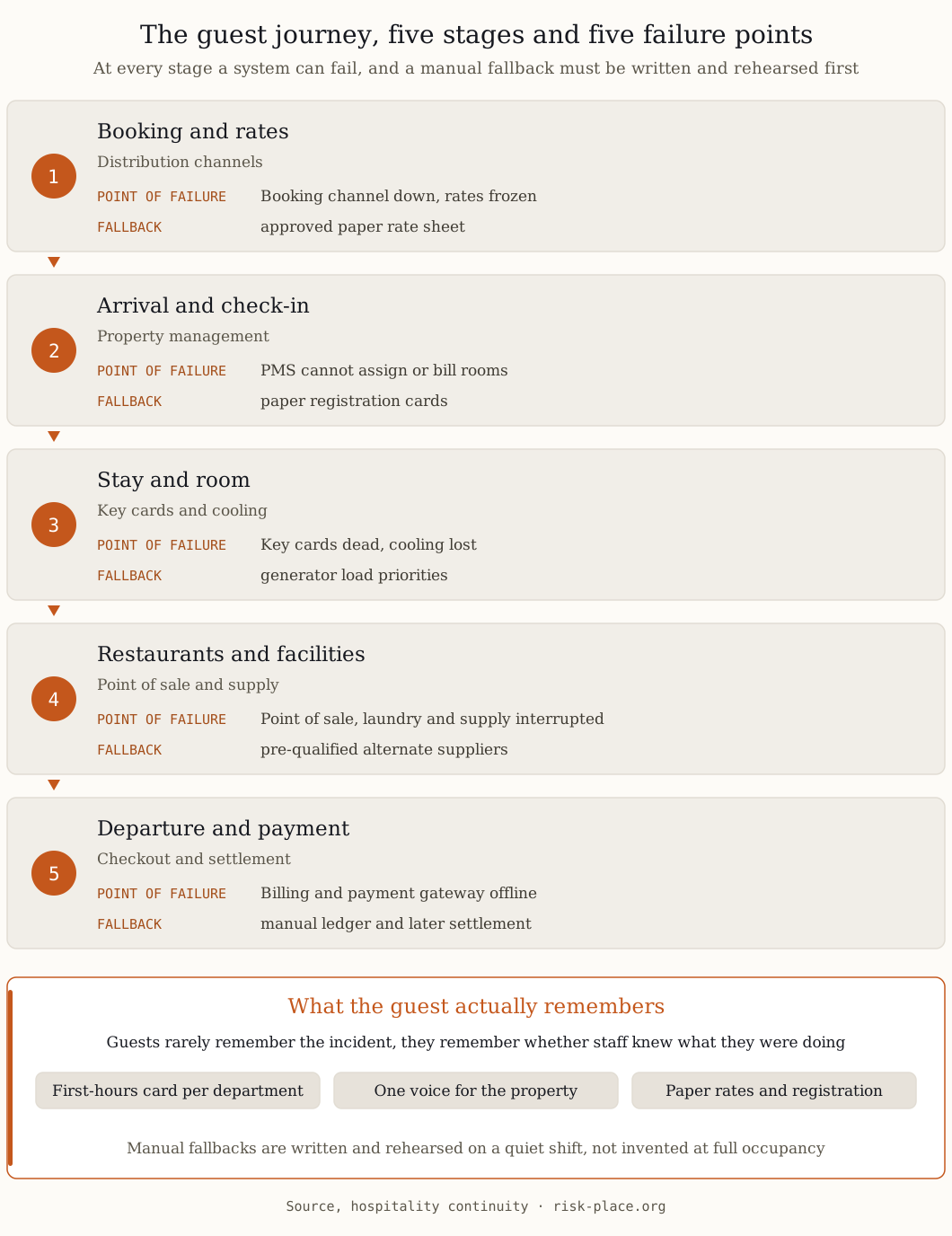
The plan, hospitality edition
- Guest communication cascade. In-room notes, lobby signage, staff scripts — prepared per scenario, translated for your guest mix.
- Manual-mode front office. Registration, billing, and key management on paper, tested on a quiet night shift at least annually.
- Departmental battle rhythm. Housekeeping, F&B, engineering, security — each with a one-page first-hours card, because a hotel crisis is fought by departments.
- Supplier fallbacks. Laundry, food, water, fuel: the single-source register matters as much here as in a factory.
- Recovery of revenue. Rebooking policies, compensation authority levels, and insurer evidence discipline — decided before the event, applied consistently during it.
Sector truth: guests rarely remember the incident — they remember whether staff seemed to know what they were doing. Rehearsal is the only thing that produces that impression.
Hotel business continuity plan: what it contains
A hotel business continuity plan is shorter than a corporate one and more physical. It is judged at the front desk at full occupancy, and it has seven parts that the sector's incidents keep proving necessary.
- Activation and authority. Who declares an incident on a night shift, and what the duty manager may decide and spend before the general manager is reached.
- Manual-mode front office. Printed arrivals and in-house lists, key cutting or a key-card fallback, folio capture on paper, a cash float, and the order in which systems come back.
- Guest communication cascade. Room, lobby, app and email in that order; who speaks to guests, who speaks to media, and the three pre-approved messages for outage, evacuation and area incident.
- Life safety and evacuation. Assembly points, guests with reduced mobility by room number, the head count method that works with 400 guests and no PMS.
- Utilities and generator load priorities. What stays powered in the first hour, what is shed, and how long fuel lasts at that load.
- Guest data and reputation. Payment card and identity data under UAE PDPL, the breach notification path, and the reputational timeline that runs in parallel with the technical one.
- Recovery and return. Rebooking and compensation authority, supplier recovery for laundry, food and transport, and the criteria for declaring the property back to normal.
The general structure of a working plan applies underneath; the hospitality edition changes the order and the vocabulary, not the logic.
Frequently asked questions
What is the difference between a hotel business continuity plan and a fire evacuation plan?
The evacuation plan gets people out of the building safely; the continuity plan keeps the business running or brings it back afterwards: rooms, revenue, guest data, suppliers. Both are needed and they reference each other, but one is life safety and the other is the business.
Who should own business continuity in a hotel?
The general manager owns it; a named deputy, usually the rooms division manager or the director of operations, runs it. It fails when it is left to IT or to security alone, because most hotel disruptions are operational, not technical.
How often should a hotel test its continuity plan?
A tabletop exercise once a year with the night-shift roles present, a manual-mode front office drill every six months, and a review after any real incident or a PMS migration. Testing during low season keeps the cost modest.
Does a management company or a brand provide the plan?
International brands provide standards and templates; the property still has to produce its own plan with its own names, generator loads and supplier contacts. Owners and insurers increasingly ask for the property-level document, not the brand standard.
Does NCEMA 7000 apply to hotels?
Directly it binds government entities and critical infrastructure. Hotels feel it indirectly: through owners' requirements, government events hosted on property, insurer questionnaires and brand standards. International flags increasingly align brand continuity requirements with local standards.
What is the minimum viable continuity package for an independent property?
Manual-mode front office, the guest communication cascade, generator load priorities, and one annual tabletop combining a systems outage with an area incident. Weeks of effort; most of the sector's realistic risk covered.
How does guest data factor into ransomware planning?
UAE PDPL makes a breach both an operational and a legal event: containment, an offline guest list to keep operating, and a notification decision path with counsel — prepared in advance, because the 72-hour clock starts with detection, not with your first meeting.