What the 2020 revision actually changed
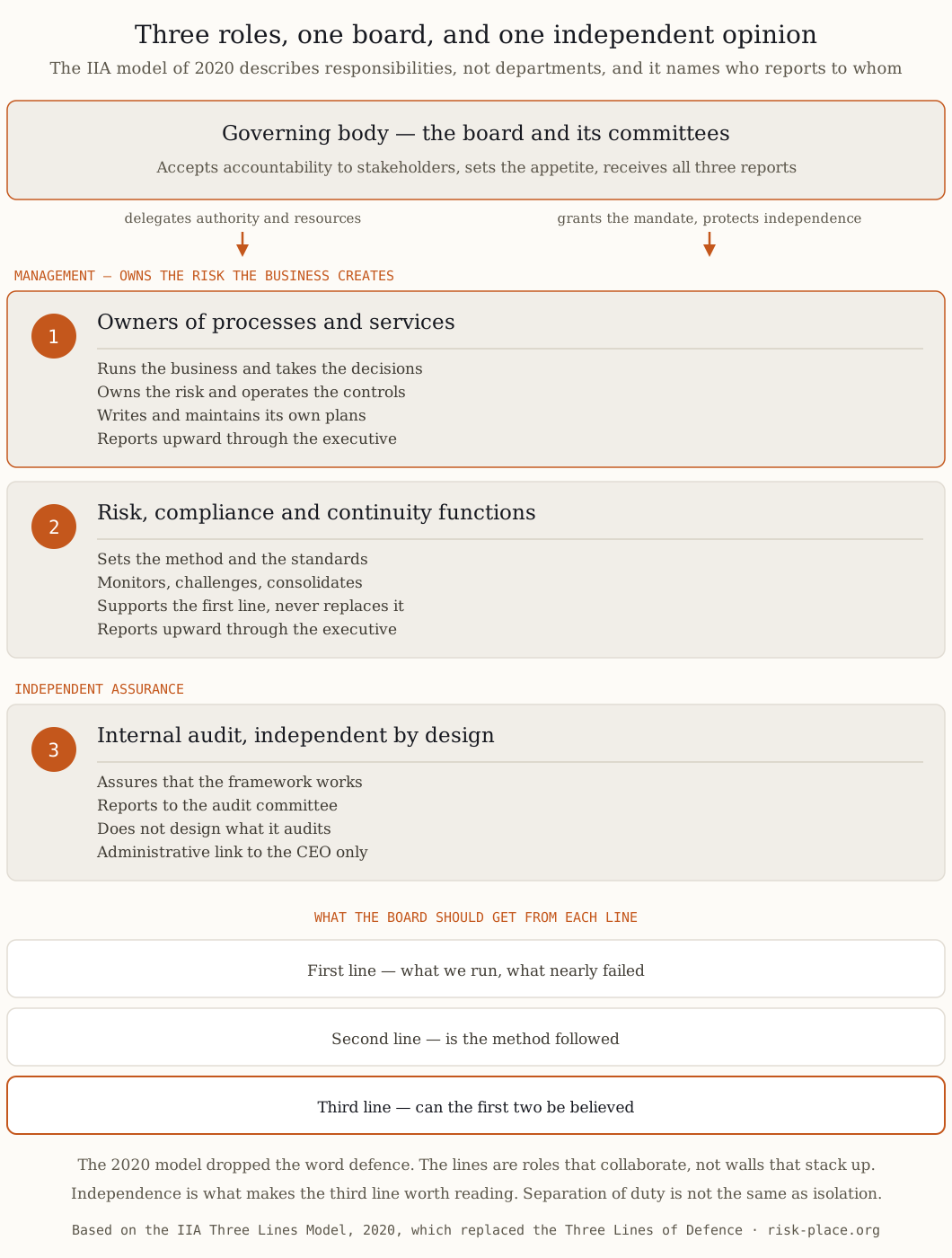
The phrase most policies still carry — "three lines of defence" — belongs to a model the Institute of Internal Auditors retired in July 2020. The replacement changed three things that matter in practice. It describes roles rather than departments, so the argument about which box a team sits in gives way to a sharper question about which of its activities are first line and which are second. It puts the governing body inside the picture rather than above it, with delegation flowing down and reporting flowing up, which forces anyone presenting the model to state who reports to whom. And it drops the military metaphor, because defence implied stacked walls and rewarded distance between the lines. One element did not change and never should — the independence of the third line. If your policy still lists three departments under the heading "lines of defence", you are explaining the 2013 version to a board that has probably read the current one.
Which line is a function on — the test that settles the argument
The dispute is almost always about the same four teams: risk, information security, quality, and continuity. Titles and reporting lines do not settle it; the nature of the activity does. Ask one question of each activity — does it create or accept an exposure on behalf of the business, or does it set method, monitor and challenge? Administering a firewall is first-line work even inside a security department, because the administrator makes the changes that create exposure. Setting the method for impact analysis, owning the exercise calendar and challenging the quality of a plan are second line. Writing the continuity plan for a service you do not run is the second line doing first-line work, the most damaging blur in this field, because it produces documents that no risk owner feels obliged to defend. One page usually ends the debate — a RACI over identify, assess, control, monitor, report and escalate, with a named function in every cell.
Five places the model breaks
- The second line does the first line's work. Registers written by the risk team, plans written by the continuity manager, and nobody in the business able to answer a question about either. It looks efficient and produces ownerless paper that fails at the first real disruption.
- Internal audit designs what it later audits. This usually happens for good reasons, because internal audit is often the strongest team in the room. It can advise on principles; the moment it writes the control, its opinion on that control is worth nothing.
- A line one and a half appears. Control teams sitting inside business units, reporting to the business but claiming independent standing. Either they are first line and should say so, or they are second line and their reporting route has to change.
- The lines never reconcile. Three reports reach the board carrying three views of the same risk, and nobody is asked to explain the difference. An assurance map listing each material risk against the evidence each line provides is the cheapest fix in governance.
- Third parties sit outside the picture. An outsourced service is still a first-line risk. Assurance over a supplier comes from your own second and third lines, or from evidence you obtained from theirs, never from the existence of a contract.
Explaining it to the board in three minutes
Directors do not need the diagram. They need to know where their comfort comes from and how much of it is independent. The script runs like this. Management runs the business and owns the risks the business creates. Specialist functions set the method and challenge what management reports. Internal audit says whether the first two can be believed. Then hand the board three questions, one per line — what nearly went wrong this quarter and what changed as a result; where the second line disagreed with the first and what happened next; and what share of the assurance in front of us is independent of the executives being assessed. The honest answer to the third is usually "a small share", and that number, not the diagram, is the real conversation. Where accountability stops being delegable is set out in our note on the board's role in resilience.
Making it operational — the artefacts that prove it exists
A model that lives only on a slide is not a control. Five artefacts make it real. A risk management policy that names three sets of responsibilities rather than three departments. Charters for the risk function and for internal audit, approved by the board or its audit committee, stating independence, access and the right to escalate. The RACI. An assurance map showing, for every material risk and every important service, which line provides what evidence, how often and to whom. And a reporting calendar in which escalation is expressed in hours rather than intentions. Then watch four health indicators — issues raised by the first line rather than found by the third, second-line challenge visible in minutes rather than in corridors, audit findings accepted with dates against names, and at least one recorded disagreement between the lines in the past year. A framework with no recorded disagreement is not harmonious, it is quiet. Building this architecture is the subject of module M6 of the ERGP programme.
Common implementation mistakes
- Publishing the diagram and changing nothing else. The picture is the easiest part of the model and the least useful on its own.
- Treating it as an organisation chart. Two hundred people can carry all three sets of responsibilities across four individuals, provided the third is independent of what it reviews and can report past the executive.
- Making the second line the police. The first line then reports only what is safe to report, and the register becomes a work of fiction that everyone has signed.
- Copying a bank's structure into a business that carries none of the same regulation. Scale the model to the risk actually being run.
- Leaving continuity and operational resilience outside the framework, so the category most likely to stop the company is the only one with no second-line challenge and no third-line opinion.
Six modules, 94 chapters, a capstone defended before the examiner and a certificate anyone can verify. The first resilience governance certification fully available in Arabic, also in English. The AE/SCNS/NCEMA 7000 module is inside.
Explore the ERGP certification →